
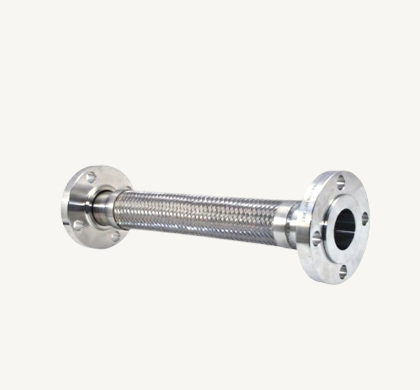
A Stainless Steel (SS) Flexible Hose Pipe is a high-performance industrial conduit designed to transport liquids and gases under extreme conditions where rigid piping would fail. Its core is typically constructed from a thin-walled, longitudinally welded stainless steel tube that is mechanically or hydraulically formed into annular corrugations. These 'bellows' provide the hose with its characteristic flexibility and ability to absorb thermal expansion, mechanical vibrations, and piping misalignments.
To handle high-pressure applications, the corrugated inner tube is reinforced with one or more layers of Stainless Steel wire braiding (usually SS 304 or 316). This braiding serves a dual purpose: it acts as a protective shield against external abrasion and, more importantly, prevents the hose from elongating axially when pressurized. By restraining this expansion, the braid allows the hose to maintain its structural integrity while still being able to bend and flex, making it ideal for dynamic systems like pump connectors or engine exhaust lines.
One of the standout features of SS flexible hoses is their incredible temperature resilience, with an operating range that typically spans from cryogenic levels (-200°C) up to intense heat (+800°C). Because they are made entirely of metal, they are fire-resistant and do not suffer from the 'permeation' issues common in rubber or plastic hoses, where gas molecules can slowly leak through the hose wall. This makes them the primary choice for transferring hazardous chemicals, high-pressure steam, and ultra-pure gases in industries like oil and gas, pharmaceuticals, and power generation.
Discover the wide range of industries and applications where Stainless Steel Flexible Hose Pipe delivers exceptional performance and reliability.
Used to move steam or hot water for applications where liquid must remain in steady temperatures, such as the food industry and pharmaceuticals, petrochemical
For aggressive chemicals and gases in chemical plants, oil refineries, gas processing factory because of their corrosion resistance.
For aggressive chemicals and gases in chemical plants, oil refineries, gas processing factory because of their corrosion resistance.
These hoses were manufactured to work under cold temperatures, allowing extremely low-temperature gases such as helium or nitrogen gas.